Shipping to Canada
Save up to 50%

Shipping to the U.S.
Save up to 75%

Shipping Internationally
Save up to 85%

Same Day Delivery
Across the GTA

Returns
Lowest rate on the market
A packing slip may be the first document your customer sees after checkout. Yet many Canadian online sellers still treat this document as an afterthought.
So, let's discuss what this piece of paper actually is, and why it matters to your business. Let's also tackle the process of generating one that supports accurate fulfillment, smooth customs clearance, and a better customer experience.
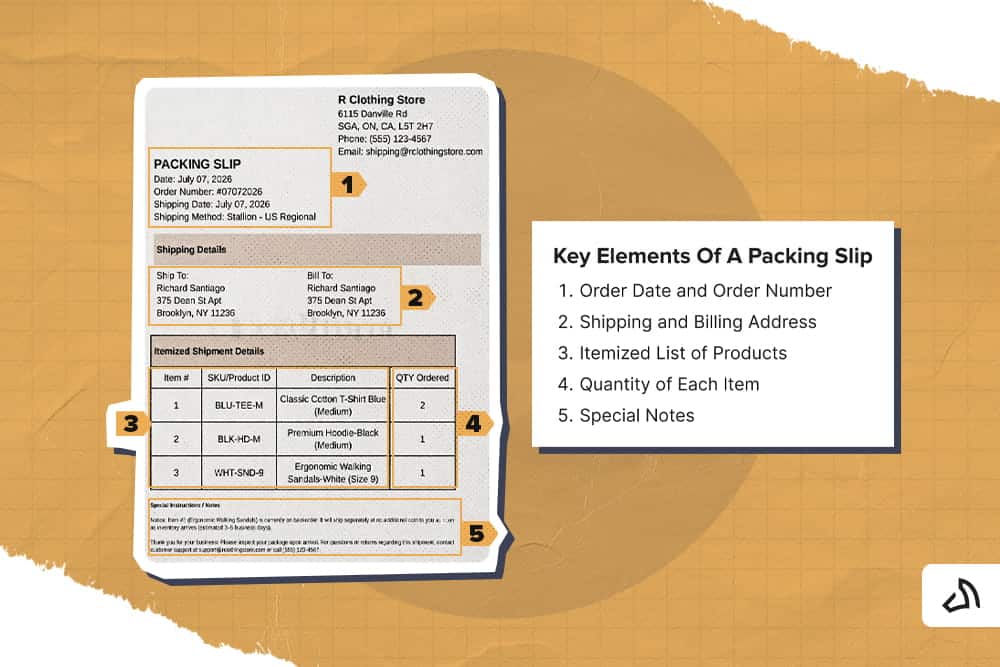
A packing slip is a document included inside a shipment that lists the contents of the box. It confirms what the customer ordered and what was actually packed. But it does not show pricing, payment method, or billing information.
Additionally, retailers, warehouses, and fulfillment centres use packing slips to confirm that they received an order and packed it correctly before they ship.
In addition to what was mentioned earlier, it serves other purposes at several stages of the order journey:
A well-built packing slip includes a consistent set of details. It doesn't matter if you created it manually or automatically through a fulfillment platform. Here are the things you should look at:
Many sellers interchange packing slip, packing list, and invoice loosely. However, only two of these terms describe the same thing. Packing slip and packing list refer to the same document, the itemized record of what is physically included in a shipment.
Some businesses and carriers favour "packing list," particularly for bulk or commercial shipments. Meanwhile, "packing slip" is more common in retail and eCommerce. Either way, this document does not include pricing, taxes, or payment information.
An invoice (or commercial invoice), on the other hand, is a different document entirely. It is a billing record that shows the cost of the order, applicable taxes and payment status.
Here’s a brief comparison between the two:
| Document | Purpose | Shows Pricing |
| Packing Slip / Packing List | List what’s in the shipment | No |
| Invoice | Billing record for the order | Yes |
For Canadian sellers, packing slips play a bigger role than many realize. Here are some of the advantages of a well-designed packing slip:
Think of them as a built-in checklist during the picking and packing process. Warehouse staff can check off each item against the slip before sealing the box. As a result, it reduces the chance of missing orders, duplicate items, or wrong products going out. For sellers with high order volume, this single step can meaningfully cut down on costly fulfillment mistakes.
You need to declare your cross-border and international packages at the border. A clear, itemized packing slip gives customs officers what they need to verify a shipment right away. As mentioned earlier, it also allows them to see the list without pricing or payment details getting in the way. This can help reduce delays at customs checkpoints.
Packing slips remove the guessing game on the side of the customers. When they open their packages, it's faster for them to confirm that they received everything they ordered.
If they need to return something, the slip often includes the order number and item details needed to start the process. These small details save the customer from digging through old emails.
Sometimes, not all packages will arrive at the customer's doorstep in one box. There can be many reasons, like warehouse location, product size, or stock availability. When this happens, it creates confusion and misunderstandings with the customer. Customers may assume their order is missing items when a second box has not arrived yet.
The slip avoids these kinds of situations. It helps customers understand that more packages are on the way, and they don't have to worry about lost orders.
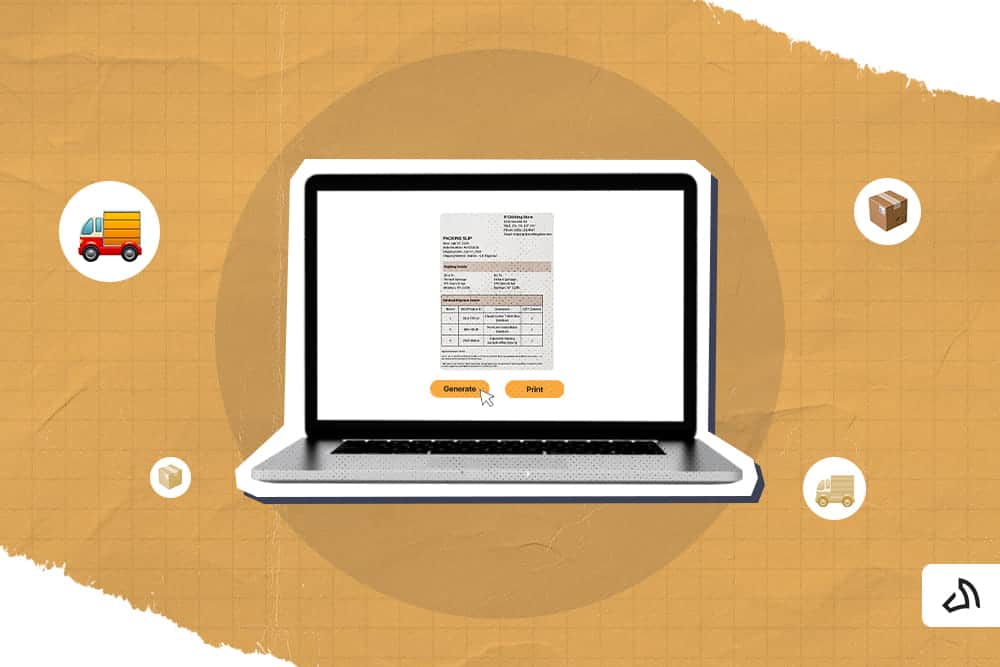
Creating packing slips doesn't have to be a manual task that eats into your day. Sellers today have two options:
Here's how each approach works:
Many businesses, especially those smaller ones, still create their packing slips manually using spreadsheets or basic templates. It requires someone to enter order details by hand for every shipment.
This approach is not entirely wrong, but it still comes with many disadvantages. It's slow, prone to typos, and difficult to scale once order volume grows.
A missed field or a copy-paste error can lead to a misplaced order or a customs delay.
Modern fulfillment platforms produce packing slips automatically as part of the order processing workflow. The order system pulls the order details, shipping addresses, and itemized product lists. This approach removes manual entry and reduces the chance of error.
For growing sellers, this kind of automation frees up time that would otherwise go toward repetitive administrative work. It also keeps packing slips consistent across every order.
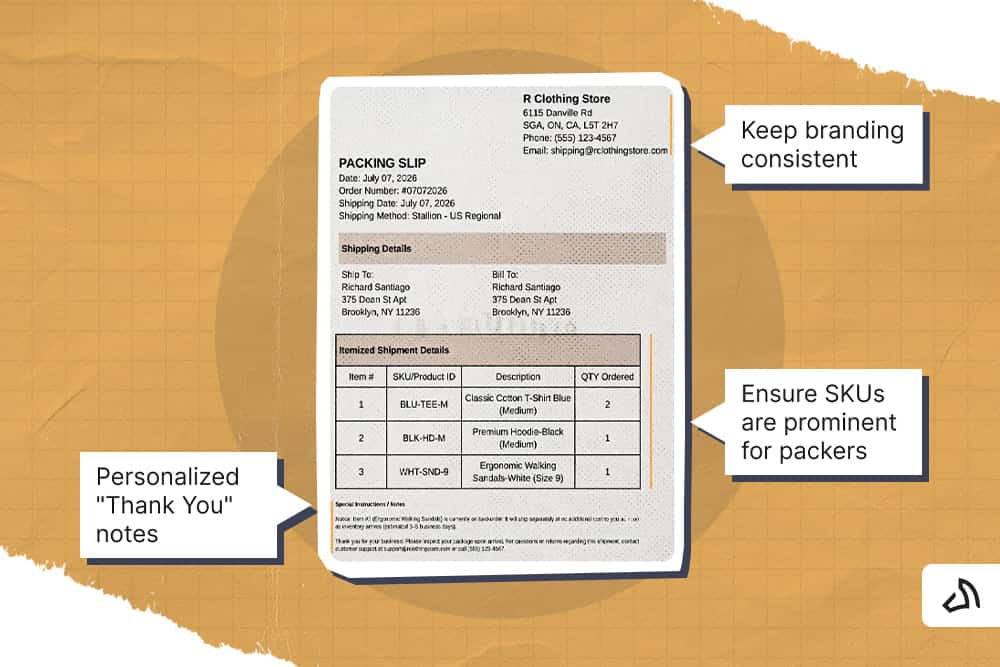
A packing slip's design matters as much as its information does. A few simple layout choices can make the document easier for your warehouse team to work with and more memorable for your customers.
When creating a packing slip template, remember to use your logo, brand colours, and consistent formatting. This will reinforce your brand identity at the moment the recipient opens their package.
While product names matter to customers, SKUs matter to the people packing the order. So, place the SKUs clearly next to each item. This speeds up the picking process and reduces the chance of a warehouse worker grabbing the wrong product.
A short, genuine thank you note on the slip is a low-cost way to make a customer feel valued. It does not need to be elaborate. A simple line of appreciation can leave a positive impression that a generic, purely transactional slip cannot.
Here are quick answers to round out what you need to know:
No federal law requires a packing slip for domestic Canadian shipments. For cross-border orders, however, some destination countries expect a contents declaration inside or attached to the package. The slip often fills that role even when it is not strictly mandatory.
Yes. Some businesses include a QR code or a link on the shipping label that lets the customer view the slip online instead of printing a paper copy. This is more common for merchants looking to cut down on paper use. Still, a printed copy is the standard for most fulfillment operations.
Most sellers can still process a return without the original slip. As long as the customer provides the order number or the email used at checkout, there should be no problem. That said, having the slip on hand speeds up the process for both the customer and the returns team.
A packing slip may seem like a small piece of paper. But it plays a role in fulfillment accuracy, customs clearance, and customer experience all at once. For Canadian businesses, getting this document correct and automating it where possible is a simple way to reduce errors and build customer trust with every order shipped.

Stallion helps Canadian online businesses automate the details that keep fulfillment running smoothly. Create accurate, professional packing slips with every order through our platform.
Book a demo or get in touch with our team to see how Stallion can support your fulfillment process from pick to delivery!

Aman looks after the content marketing department at Stallion Express. He is passionate about helping businesses grow by providing informative and up-to-date trends in the eCommerce industry. Outside the office, you can find him on the soccer field cheering on Real Madrid.


Can our fellow Torontonians relate?
-
#smallbusiness #business #entrepreneur #socialmedia #shipping #ecommerce #canadianecommerce #shopify #poshmark #b2b #saas #etsy #ebay #canada #canadiansmallbusiness #shoplocalcanada #entrepreneur
#toronto

Here’s your quick hassle free shipping from 🇨🇦 to 🇺🇸 as a business owner!
-
Any questions?! Leave them 👇🏻 and save this video so you don’t forget!
-
#smallbusiness #business #entrepreneur #socialmedia #shipping #ecommerce #canadianecommerce #shopify #poshmark #b2b #saas #etsy #ebay #canada #canadiansmallbusiness #shoplocalcanada #entrepreneur
Meet @drinkbenny a 🇨🇦 female founded energy drink brand! Instead of focusing on their products, they’re taking a unique approach by hosting in person events in different Canadian cities to offer an experience for their community 🧡
-
What are your thoughts on in person events? 💭
-
#smallbusiness #business #entrepreneur #socialmedia #shipping #ecommerce #canadianecommerce #shopify #poshmark #b2b #saas #etsy #ebay #canada #canadiansmallbusiness #shoplocalcanada #entrepreneur
Do you know the difference between DDU and DDP when shipping internationally 🌏 ?
-
Questions? Leave them below! 👇🏻
-
#smallbusiness #business #entrepreneur #socialmedia #shipping #ecommerce #canadianecommerce #shopify #poshmark #b2b #saas #etsy #ebay #canada #canadiansmallbusiness #shoplocalcanada #entrepreneur
Here’s a quick hack to save time from choosing multiple postage options
↪️ Turn on the lowest postage rate automation to save you time!
-
Questions? Leave them below! 👇🏻
-
#smallbusiness #business #entrepreneur #socialmedia #shipping #ecommerce #canadianecommerce #shopify #poshmark #b2b #saas #etsy #ebay #canada #canadiansmallbusiness #shoplocalcanada #entrepreneur