Shipping to Canada
Save up to 50%

Shipping to the U.S.
Save up to 75%

Shipping Internationally
Save up to 85%

Same Day Delivery
Across the GTA

Returns
Lowest rate on the market
International shipping comes with many documents, including the commercial invoice. Get it wrong, and your shipment can sit at customs for days. Get it right, and it clears without a second look.
But what is this piece of paper actually, and why does it matter? What does it need to include? What are the common mistakes that trip up Canadian sellers most often? Let's break down all these questions in this blog.
A commercial invoice is a legal shipping document that goes along with an international shipment. It tells customs officials in the destination country what is being shipped, the sender and receiver's names, and the value of the goods.
Customs authorities use this document to calculate duties and taxes. But more importantly, it helps them decide whether the shipment can enter the country.
So for cross-border and international shipping, a commercial invoice is not optional. Every shipment going outside of Canada needs one, whether you are sending one parcel or a full pallet.
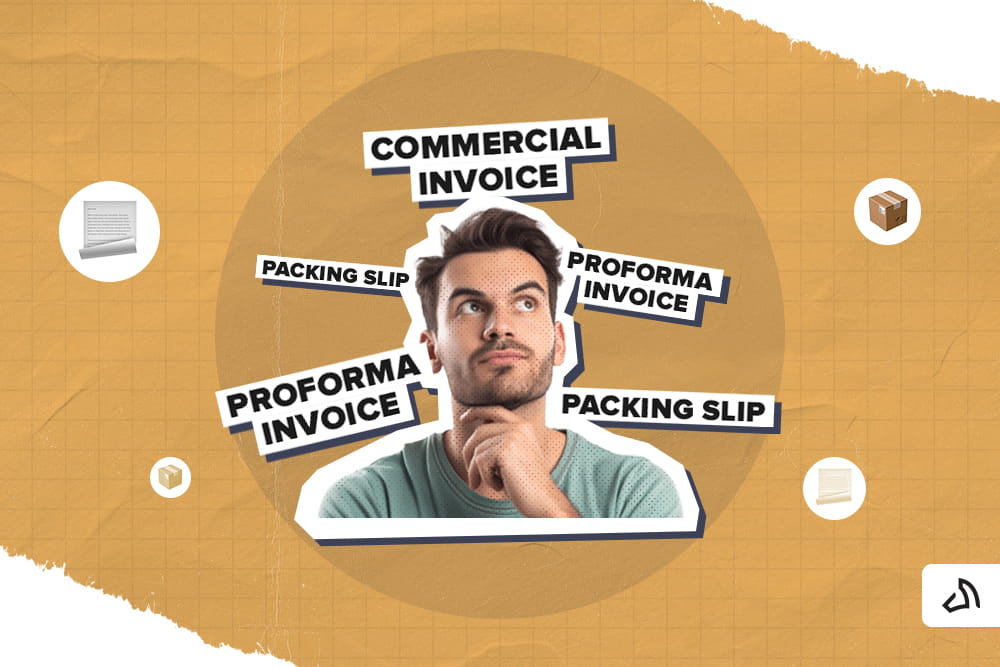
Commercial invoices, proforma invoices, and packing slips often get mixed up. But sellers should know that they serve different purposes. Here's what you should know about these three documents:
As mentioned, a commercial invoice is an official customs document that lists the goods, their value, and other details required to clear the shipment through customs. Customs authorities use it to assess duties and taxes.
A packing slip, on the other hand, is a list of what is physically inside the package. It helps the recipient confirm that they have received their orders correctly. Customs does not use this document to calculate duties. It is not legally required to issue one, but it can help make the fulfillment process run more smoothly.
Meanwhile, a proforma invoice is a preliminary note sent before finalizing a sale. It gives the buyer a heads-up of the estimated costs before they complete their shopping transactions.
Sometimes, customs also use it when the final commercial invoice is not yet available. However, it is not a substitute for the real thing.
Knowing the difference matters because using the wrong document, or leaving one out, can hold up your shipment at the border.
The table below breaks down how these three documents compare.
| Document | Purpose | Used By Customs? |
| Commercial Invoice | States the goods, their value, and shipment details for customs clearance | Yes |
| Packing Slip | Lists the physical contents of the package for the receiver | No |
| Proforma Invoice | Gives the buyer an estimated cost before the sale is finalized | Sometimes, as a placeholder only |
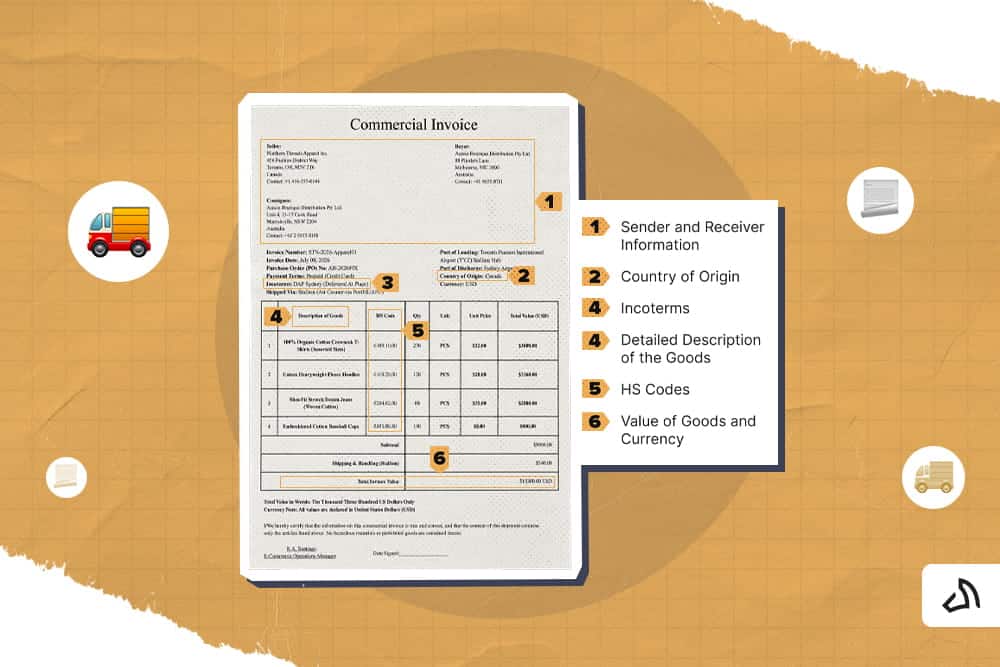
A commercial invoice is only useful if it includes the right information. Missing or incomplete details are one of the most common reasons shipments get held up at customs. Here is what every commercial invoice template must include:
Every commercial invoice needs all details for both the shipper and the recipient. It should indicate their full names, address, and contact information. Sellers can also include their business name if applicable.
Each item in the shipment needs a clear, specific description. "Clothing" is not enough as a description. It's vague and could mean anything. "Men's cotton t-shirt, size medium", on the other hand, gives customs what they need to classify the item correctly. The more specific the description, the less likely customs will flag the shipment for review.
Harmonized System Codes, or HS Codes, are standardized numbers to classify traded products. Customs authorities around the world use these digits to determine duty rates.
They also use them to confirm what the shipper has imported to the country. Every item on a commercial invoice should have the correct HS code attached.
This section is basically straightforward. It indicates each item's value and the currency used in the transaction.
This value is what customs uses to calculate duties and taxes. Therefore, it needs to reflect the actual transaction price, not an estimate or a placeholder number.
The country of origin states the location where the goods were manufactured or produced. But it does not necessarily mean the country you are shipping from.
For example:
You are shipping from Canada, but your products were manufactured in China. In this case, you must put China as the country of origin.
The country of origin affects duty rates, and customs officers may require it for eligibility under international trade agreements.
Incoterms tell both the sender and receiver who will pay for the shipping costs, insurance, and duties at each stage of the shipment's journey. Common examples include DDP (Delivered Duty Paid) and DAP (Delivered at Place). Adding the correct Incoterm avoids confusion about who is responsible for what at delivery.
To see how one of the Incoterms (DDP) works in practice, check out our guide on shipping to the Dominican Republic from Canada.
Even experienced sellers run into some issues on their commercial invoices. What are these mistakes when creating one, and how can you avoid them? Here are the common errors you should avoid at all costs:
As mentioned, generic product descriptions do not give customs enough information to classify the goods correctly. This can lead to delays, additional inspection, or shipment returns.
Resolving this issue is very easy, though. Just remember always to describe what the item is, what its materials or ingredients are, and what it is used for.
We already know by now that the unit price and total value determine the shipment's duties, taxes, and tariffs. With this in mind, it may be tempting to declare a lower value to reduce duties for the recipient.
However, it is not just a bad idea. It is actually illegal in most jurisdictions and can result in fines, seized shipments or bans from future shipping.
The declared value should always match the actual sale price.
Let's say you accidentally leave off the code or use the wrong one. Customs may hold the shipment and will need to determine and verify the correct classification themselves.
This adds time and, sometimes, additional fees. Confirming the correct code before shipping avoids this entirely.
You can review this HS Code file to see which section your package is under.
Here are answers to some common questions Canadian sellers have about commercial invoices:
Yes. Most countries will look for a commercial invoice for international shipping. And it doesn't matter what the shipment's value is. In fact, some low-value shipments may qualify for simplified customs treatment. But the invoice itself is still required.
This depends on the country where you will export your product and the courier. But a common standard is three copies. Check with your carrier on how many copies you may need to submit. Some may need the invoice attached to the outside of the package as well as included inside.
The exporter will provide accurate information, since they know the goods, their value, and their origin. Many shipping platforms, including Stallion, generate the invoice for you using the shipment details you provide.
No. You must submit the commercial invoice for each shipment individually.
For most major destinations, you can use English. But some countries require the invoice in the local language or bilingual format. It is worth checking the requirements for your specific destination country.
A commercial invoice might seem like just a small piece of paperwork. However, it directly affects whether your shipment clears customs smoothly or gets stuck at the border.
Canadian sellers who take the time to fill out a commercial invoice accurately save themselves delays, unexpected costs, and unhappy customers.

Stallion helps Canadian sellers generate accurate commercial invoices as part of the shipping process. Our system automatically pulls in the details needed for customs, instead of requiring manual entry for every shipment.
We can help you comply with customs rules without the added headaches.
With Stallion, sellers get:
Ready to simplify your cross-border shipping? Get started with Stallion today.

Jose is Stallion's Senior Business Analyst. He helps improve the company’s shipping processes, works closely with delivery partners, and looks at shipping data to find the best prices for our customers. Outside of work, Jose has a passion for running, regularly completing 5k and 10k runs, with the goal of running a full marathon in the near future.
Can our fellow Torontonians relate?
-
#smallbusiness #business #entrepreneur #socialmedia #shipping #ecommerce #canadianecommerce #shopify #poshmark #b2b #saas #etsy #ebay #canada #canadiansmallbusiness #shoplocalcanada #entrepreneur
#toronto

Here’s your quick hassle free shipping from 🇨🇦 to 🇺🇸 as a business owner!
-
Any questions?! Leave them 👇🏻 and save this video so you don’t forget!
-
#smallbusiness #business #entrepreneur #socialmedia #shipping #ecommerce #canadianecommerce #shopify #poshmark #b2b #saas #etsy #ebay #canada #canadiansmallbusiness #shoplocalcanada #entrepreneur
Meet @drinkbenny a 🇨🇦 female founded energy drink brand! Instead of focusing on their products, they’re taking a unique approach by hosting in person events in different Canadian cities to offer an experience for their community 🧡
-
What are your thoughts on in person events? 💭
-
#smallbusiness #business #entrepreneur #socialmedia #shipping #ecommerce #canadianecommerce #shopify #poshmark #b2b #saas #etsy #ebay #canada #canadiansmallbusiness #shoplocalcanada #entrepreneur
Do you know the difference between DDU and DDP when shipping internationally 🌏 ?
-
Questions? Leave them below! 👇🏻
-
#smallbusiness #business #entrepreneur #socialmedia #shipping #ecommerce #canadianecommerce #shopify #poshmark #b2b #saas #etsy #ebay #canada #canadiansmallbusiness #shoplocalcanada #entrepreneur
Here’s a quick hack to save time from choosing multiple postage options
↪️ Turn on the lowest postage rate automation to save you time!
-
Questions? Leave them below! 👇🏻
-
#smallbusiness #business #entrepreneur #socialmedia #shipping #ecommerce #canadianecommerce #shopify #poshmark #b2b #saas #etsy #ebay #canada #canadiansmallbusiness #shoplocalcanada #entrepreneur