New EU Customs Rules for Low-Value Shipments Start November 1, 2026
Starting November 1, 2026, every low-value B2C parcel entering the European Union must include Product Identifiers (PIDS) for each item. A new €2 customs handling fee also applies to each declaration line. "Low-value" means an intrinsic value under €150.
If you ship from Canada to customers in the EU, these rules affect your product data, landed costs, and EU pricing. This guide explains what is changing, what it costs and what to do before the deadline.
Key Changes at a Glance
| Effective Date | What Changes | Applies To |
| July 1, 2026 (already in effect) | €3 flat customs duty per declaration line | All B2C shipments under €150 into the EU |
| November 1, 2026 | PIDs become mandatory for every declared product line | All B2C shipments into the EU, any value |
Missing or incorrect PID information may delay customs clearance.
What Is A Product Identifier (PID)?
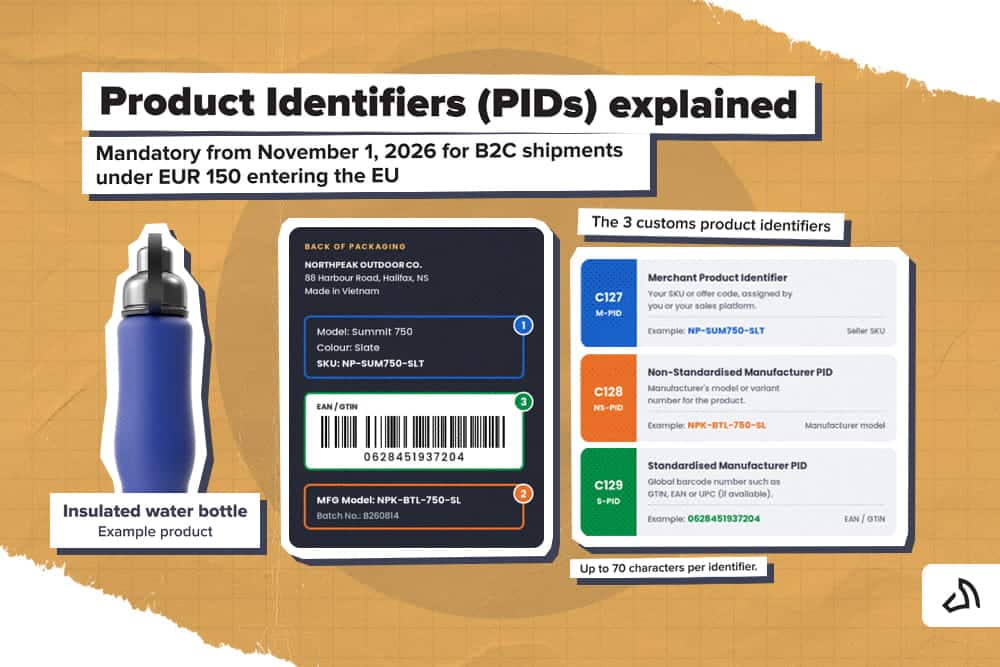
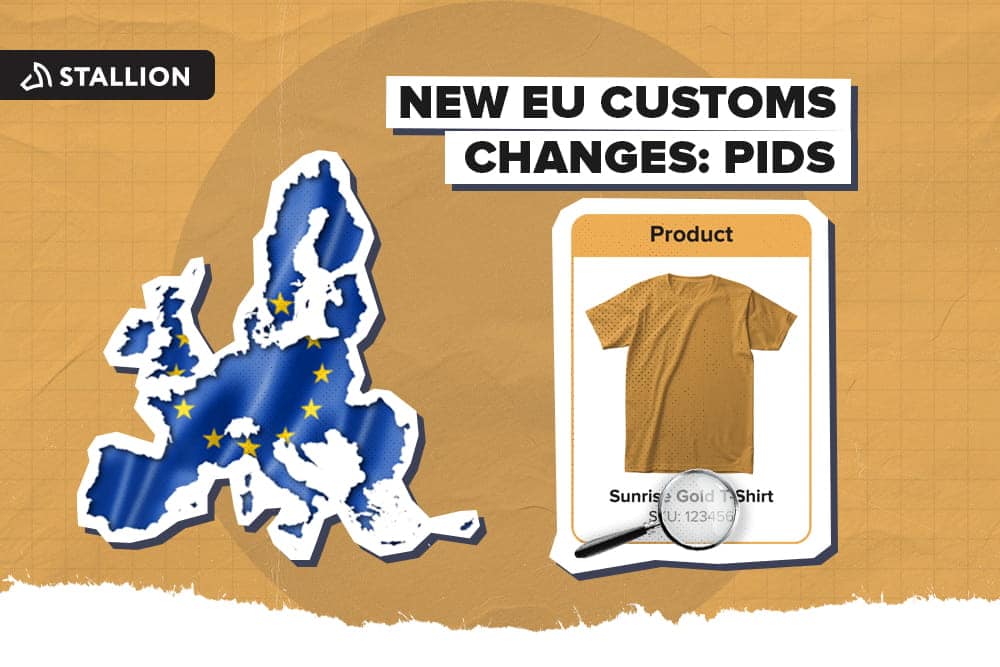
A PID is a product-level code that tells EU customs what is in the parcel. It supports product traceability, risk assessment and product safety checks.
Stallion requires PIDs on every EU-bound product, including orders over €150. Without them the label cannot be purchased.
For each product line you declare, up to three PIDs apply:
- Merchant PID (M-PID, customs code C127). Your own SKU or product reference. This is the code you or your sales platform use to identify the item.
- Non-standardized Manufacturer PID (NS-PID, customs code C128). The manufacturer's model or variant number. It is usually printed on the packaging or product label.
- Standardized Manufacturer PID (S-PID, customs code C129). A globally recognized barcode number, such as a GTIN, EAN, UPC or ISBN, where one exists.
Each PID can be up to 70 characters. Most of this information is already on your packaging or in your store's product catalogue.
Which PIDS Are Required?
The required PIDs depend on the product type:
| Product Type | Merchant PID | Manufacturer PID | Standardized PID |
| Normal goods (most products) | Required | Required | If available |
| Medical devices | Required | Required | UDI-DI identifier if available |
| Pharmaceuticals and OTC medicine | Required | Required | If available |
| Handmade or artisan products, antiques, collectibles, art, stamps and coins, unprocessed agricultural or perishable goods | If available | If available | If available |
If a product has no standardized barcode, the declaration uses a standard “not available” code in its place.
How Your EU Landed Costs Change
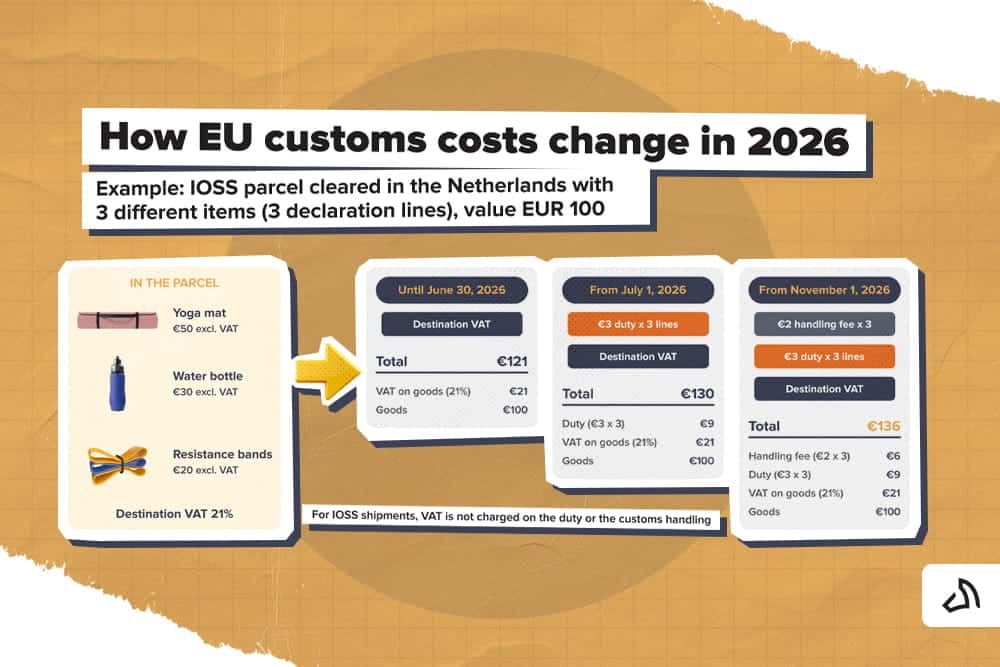
Two charges apply per declaration line, in addition to destination VAT:
- €3 customs duty per line (in effect since July 1, 2026)
- €2 customs handling fee per line (new from November 1, 2026)
From November 1, 2026, a parcel with three different items carries €15 in duties and handling fees, plus VAT.
Here's an example:
An IOSS parcel cleared in the Netherlands (21% VAT). It has three items worth €100 in total: a yoga mat (€50), a water bottle (€30), and resistance bands (€20).
| Charge | Until June 30, 2026 | From July 1, 2026 | From November 1, 2026 |
| Goods | €100 | €100 | €100 |
| VAT (21% on goods) | €21 | €21 | €21 |
| Customs duty (€3 x 3 lines) | None | €9 | €9 |
| Customs handling fee (€2 x 3 lines) | None | None | €6 |
| Total | €121 | €130 | €136 |
For IOSS shipments, the EU will not charge VAT on the duty or the handling fee.
The fees apply per line, not per parcel. A customer who buys three different items pays more in fees than a customer who buys one item. This matters most for stores with low average order values and multi-item carts.
What To Do Now
Start gathering PID data for the products you sell into the EU, so you are ready when the new fields go live.
- Collect your SKUs. Make sure every product you ship to the EU has a unique SKU in your store or catalogue.
- Find manufacturer model numbers. Check packaging, product labels or supplier spec sheets for the model or part number.
- Record barcodes. Note the GTIN, EAN or UPC for each product where one exists.
- Review HS codes and descriptions. Accurate, consistent customs data supports faster clearance.
- Update your EU pricing. Include the €3 duty and €2 handling fee per line in your EU shipping rates or product prices.
What Stallion Is Doing
Stallion is working with our international partner carriers to implement these changes.
Product Information Fields Are Now Available
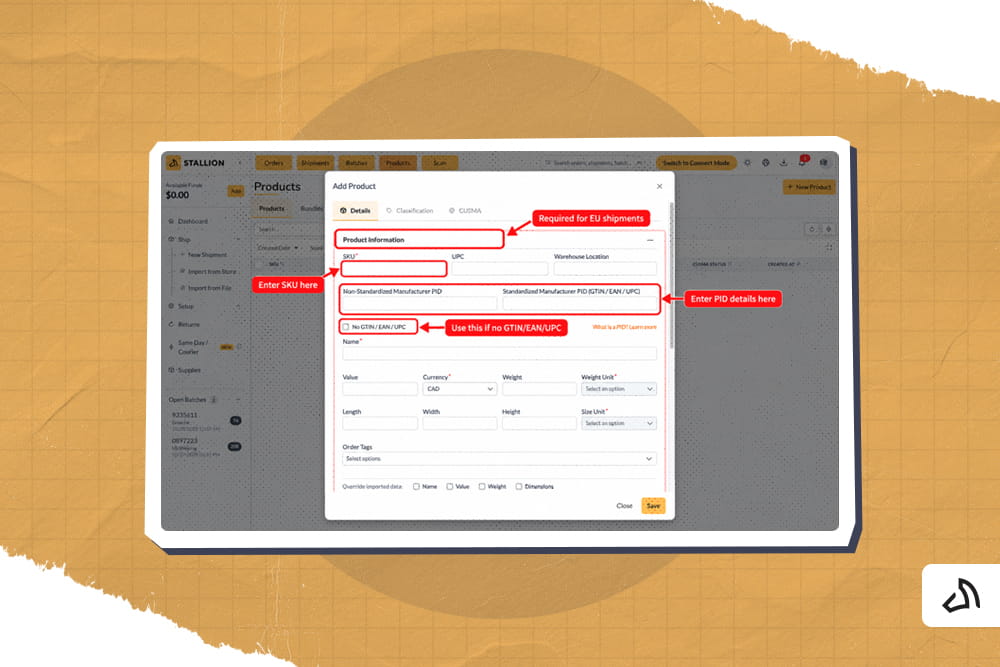
The Product Information fields are now available on the Products page. These details will be required for shipments entering the EU starting November 1, 2026.
Important: Shipments with missing product information risk being rejected upon entry into the EU.
Questions? Contact your account manager or email hello@stallion.ca.
Frequently Asked Questions
When do the new EU customs rules for low-value shipments start?
PIDs and the €2 handling fee start on November 1, 2026. The €3 duty per line has been applied since July 1, 2026.
Which shipments do the rules apply to?
The €3 duty and €2 handling fee apply to B2C parcels under €150. Product identifiers are required on every product line shipped to EU customers, whatever the value.
Do I need a barcode for every product?
No. A standardized barcode is required only where one exists. If a product has none, the declaration uses a standard "not available" code.
Are the fees charged per parcel or per item?
Both charges apply per declaration line, meaning per item in the parcel.