Shipping to Canada
Save up to 50%

Shipping to the U.S.
Save up to 75%

Shipping Internationally
Save up to 85%

Same Day Delivery
Across the GTA

Returns
Lowest rate on the market
Cross-Canada shipping may appear plain and easy. However, sometimes, it isn't as straightforward as it looks on the map. Logistics and costs are just some of the issues that can catch new sellers off guard.
But what other issues should you, as a seller, also be aware of? This guide breaks down what actually drives shipping costs across Canada and how to keep them under control.
Shipping within Canada sounds like it should be simpler than shipping internationally. The sad news? It isn't.
Canada is the second-largest country in the world by land area. However, most of its population is across a handful of urban centres, with vast distances between them.
Think of it this way:
A package travelling from Vancouver to Halifax covers nearly 4,700 kilometres. It's more than the distance from London to Moscow.
This geography creates real headaches for online sellers. Plus, they don't have as many shipping companies as in the US. The delivery times can also stretch out in rural and northern areas. And costs climb quickly once you're shipping outside a major metro corridor.
Add in provincial differences in remote surcharges and delivery infrastructure. It's easy to see why so many Canadian sellers feel like they're paying a premium to reach their own customers.
Several factors combine to determine the price of a domestic shipment. Here's what actually goes into the cost:
As mentioned, Canada's vast size means many shipments travel long distances between major population centres. And with this, the carriers price accordingly.
Rural, northern, and remote postal codes almost always carry extra fees.
The reason? Fewer trucks and less infrastructure serve those areas. Sellers based outside the Toronto-to-Montreal corridor often absorb a real cost advantage simply because of their location.
Canada Post, Purolator, and a small group of national players have historically controlled most of the domestic shipping market. This dilemma takes competitors out of the equation.
As a result, pricing power sits more with couriers than with shippers. It particularly affects small and medium businesses without volume leverage.
Shipping companies charge based on whichever is greater: actual or dimensional weight. The process is simple: calculate the box's length, width, and height. So, it's crucial to pack the parcel properly.
For instance:
A large, lightweight box can cost more to ship than a small, heavy one. Why? Because it takes more space than the smaller package.
Sellers who don't size their package to their product often end up paying for empty air.
Canadian shipping solutions divide the country into shipping zones. The domestic shipping rates increase as packages cross more zone boundaries.
Take this as an example:
A freight shipment from Toronto to Ottawa stays within a relatively short zone hop. On the other hand, the Toronto-to-Whitehorse route crosses several zones. While you are both technically sending packages across Canada, the latter will cost the seller substantially more.
There are plenty of surcharges that you need to be aware of, such as:
Unfortunately for sellers, these can all add to the base rate they must pay. These fees change periodically and aren't always obvious upfront. With this, it's easy for costs to creep up beyond what you expected if you don't check your invoices closely.
The good news is that shipping costs aren't fixed. A few practical changes can start saving money right away:
Switching to right-sized packaging is one of the fastest ways to reduce dimensional weight charges. You're getting rid of those excess spaces that will only increase your costs.
So what are you going to do? Don't default to a single box size for everything. Instead, measure your products and choose boxes that fit them closely. Lighter, more compact packaging materials also help reduce actual weight without sacrificing protection.
Relying on a single shipping partner can mean convenience for many sellers. However, it can also mean accepting whatever rates and shipping service levels they offer.
The best you can do is to compare rates across multiple courier services for each shipment. Then, route each order to the service option that offers the best combination of cost and delivery speed.
This way, you can meaningfully lower your average shipping cost over time.
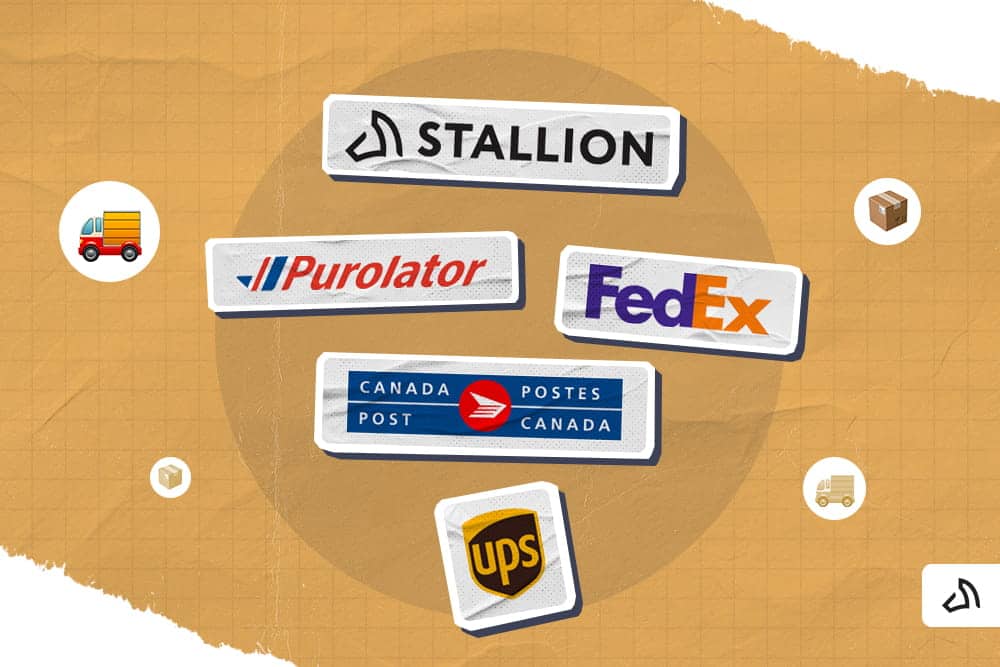
Not all shipping options perform the same across all regions or shipment types. Here's a closer look at the major players and where each one stands out:
Stallion gives online sellers access to discounted rates across multiple major shipping partners through a single platform. This removes the need to negotiate separately with each one.
Additionally, this access makes it easier for growing businesses to ship affordably without sacrificing service quality.
What Stallion Offers:
Canada Post offers the widest reach across the country. This includes rural and remote communities that other delivery options may not service directly. It's often a strong choice for businesses that need guaranteed delivery to every corner of Canada. But note that costs can run higher for parcels compared to other options.
What Canada Post Offers:
Even though it is majority-owned by the national courier, Purolator operates independently and has its own network.
You may have heard of it for its reliable next-day and two-day delivery options within major Canadian corridors. It tends to work well for businesses that prioritize speed for time-sensitive shipments.
What Purolator Offers:
Alongside its domestic Canadian service, FedEx also has one of the strongest international infrastructure in this list. It's especially helpful for sellers shipping both within Canada and across borders.
Domestic rates are competitive in major centres. On the downside, it can be higher in less-served areas.
What FedEx Offers:
UPS offers strong support for businesses shipping across the border. Sellers can focus on managing overall shipping costs because UPS provides competitive options for both domestic and cross-border volumes.
What UPS Offers:
Smaller regional carriers can offer more competitive pricing within specific provinces or metro areas, especially for same-day or next-day local delivery. If you need to ship primarily within one region, these companies are worth considering.
They can act as supplements to national couriers rather than a full replacement. This can help your business a lot, particularly if a large share of your customer base sits there.
What Regional Carriers Offer:

Getting a package delivered is only half the job. Here's how to keep customers satisfied throughout the process, no matter how far they are.
It doesn't matter whether you're a start-up or a well-established company. Your customer will expect the same visibility into their order that they'd get from any major store. Providing clear tracking updates helps manage expectations.
It also reduces support inquiries, helping you focus more on your business. This is especially beneficial for shipments to rural or remote areas where delivery windows may be longer.
Longer distances and more handling points only mean one thing. There's a huge opportunity for damage or loss of shipments.
Offering package protections not only safeguards your customers' orders. It also protects your business and gives buyers confidence when ordering from farther away.
Returns can complicate your operations, especially if your customers are all over Canada. To make it smooth, ensure clean return policies and accessible return shipping options. This builds the kind of trust that keeps customers ordering again regardless of which province they're in.
We answer the most common questions Canadian eCommerce sellers ask when scaling their Cross-Canada shipping with Stallion.
No. Stallion operates exclusively as a commercial shipping solution for eCommerce sellers, online merchants, and businesses shipping orders to customers.
Yes. Stallion integrates directly with Canada Post (including Canada Post ZoneSkip options). Sellers can deliver to any valid Canadian postal address, including remote locations, rural routes, and PO boxes that traditional private couriers cannot reach.
Stallion provides a dedicated domestic returns portal. Sellers can generate pre-paid domestic return labels at discounted commercial rates. This allows out-of-province customers to easily drop off return parcels at any local carrier point while giving sellers real-time return tracking.
Cross-Canada shipping comes with real challenges. You have to face issues such as geography, dimensional weight rules, and stacking charges. But none of these are permanent costs you're stuck with.
All of these factors add up to meaningful savings and better service. You can reach customers no matter where they are in Canada.
From coast to coast, Stallion makes shipping within Canada simpler and more affordable for online sellers.
No more juggling multiple accounts or overpaying to reach customers outside major metro areas.
Ship smarter across every province. Get started with Stallion today.

Aman looks after the content marketing department at Stallion Express. He is passionate about helping businesses grow by providing informative and up-to-date trends in the eCommerce industry. Outside the office, you can find him on the soccer field cheering on Real Madrid.

Can our fellow Torontonians relate?
-
#smallbusiness #business #entrepreneur #socialmedia #shipping #ecommerce #canadianecommerce #shopify #poshmark #b2b #saas #etsy #ebay #canada #canadiansmallbusiness #shoplocalcanada #entrepreneur
#toronto

Here’s your quick hassle free shipping from 🇨🇦 to 🇺🇸 as a business owner!
-
Any questions?! Leave them 👇🏻 and save this video so you don’t forget!
-
#smallbusiness #business #entrepreneur #socialmedia #shipping #ecommerce #canadianecommerce #shopify #poshmark #b2b #saas #etsy #ebay #canada #canadiansmallbusiness #shoplocalcanada #entrepreneur
Meet @drinkbenny a 🇨🇦 female founded energy drink brand! Instead of focusing on their products, they’re taking a unique approach by hosting in person events in different Canadian cities to offer an experience for their community 🧡
-
What are your thoughts on in person events? 💭
-
#smallbusiness #business #entrepreneur #socialmedia #shipping #ecommerce #canadianecommerce #shopify #poshmark #b2b #saas #etsy #ebay #canada #canadiansmallbusiness #shoplocalcanada #entrepreneur
Do you know the difference between DDU and DDP when shipping internationally 🌏 ?
-
Questions? Leave them below! 👇🏻
-
#smallbusiness #business #entrepreneur #socialmedia #shipping #ecommerce #canadianecommerce #shopify #poshmark #b2b #saas #etsy #ebay #canada #canadiansmallbusiness #shoplocalcanada #entrepreneur
Here’s a quick hack to save time from choosing multiple postage options
↪️ Turn on the lowest postage rate automation to save you time!
-
Questions? Leave them below! 👇🏻
-
#smallbusiness #business #entrepreneur #socialmedia #shipping #ecommerce #canadianecommerce #shopify #poshmark #b2b #saas #etsy #ebay #canada #canadiansmallbusiness #shoplocalcanada #entrepreneur