Shipping to Canada
Save up to 50%

Shipping to the U.S.
Save up to 75%

Shipping Internationally
Save up to 85%

Same Day Delivery
Across the GTA

Returns
Lowest rate on the market
If you're a Canadian online seller, you've likely encountered various "PL" terms when researching logistics solutions. There are 2PL, 3PL, 4PL, and so on. It can feel like a lot to take in, but don't worry, let's start with the basics.
In this blog, we'll break down what 2PL means, the services it covers, and how it compares to 3PL.
2PL (second-party logistics) refers to logistics companies that directly own and operate the transportation assets used to move goods. These transportation assets can be trucks, ships, and planes that logistics providers use to deliver your products from one location to another within the supply chain.
In other words, 2PLs focus strictly on transportation. So, if your priority is moving goods and not storing them in a warehouse, or if you choose to outsource fulfillment tasks, a 2PL may be all you need.
Note: Don't confuse this two-phase locking, which is another meaning for 2PL. It has nothing to do with logistics or carriers.
Now that you know what a 2PL is, let’s look at the traits that make them unique. Here are some characteristics that help explain where a 2PL fits in the logistics chain:
As mentioned, a 2PL owns and operates the physical assets needed for transportation. This direct control over vehicles and equipment often results in greater reliability because you're working with the service providers that physically move your goods.
For example:
You hired a trucking company to move freight from Toronto to Vancouver. This company provides a fleet of vehicles, drivers, and fuel, everything needed to complete the delivery. Unlike a freight broker or 3PLs, no middleman is coordinating with multiple carriers.
The relationship with a 2PL is usually straightforward and service-based. You book a shipment, and the shipping companies deliver it. There's minimal involvement beyond pickup and drop-off. Simply put, it's more like a transactional purchase than an ongoing partnership.
For example:
Let's say you booked an Uber ride. You request a ride, they take you where you need to go, and that's the end ot the transaction.
Similarly, when you use 2PL, there's no deep integration with your inventory management, order systems, or customer service. It is just a straightforward transportation.
Again, a 2PL's core focus is transportation. They typically do not offer warehousing, fulfillment, or reverse logistics (returns).
For example:
You run an online store selling home décor and need a place to store your products until an order comes in. A 2PL can move your products from a supplier to your warehouse, but won't provide the warehouse space itself.
For businesses that require a broader range of services, such as order picking, packing, and distribution to end customers, providers like 3PLs and 4PLs might be a better fit.
Since 2PL providers specialize in just one area, they can often deliver competitive pricing and efficiency in transportation. It is an attractive choice for businesses that only need point-to-point shipping within their logistics operations.
For example:
You're shipping a bulk clothing order from a Canadian supplier to your warehouse in the US. Since you only need someone to deliver your items, hiring a 2PL trucking company may be the most economical and straightforward option.
You pay only for transportation without additional service layers, which helps keep costs down.
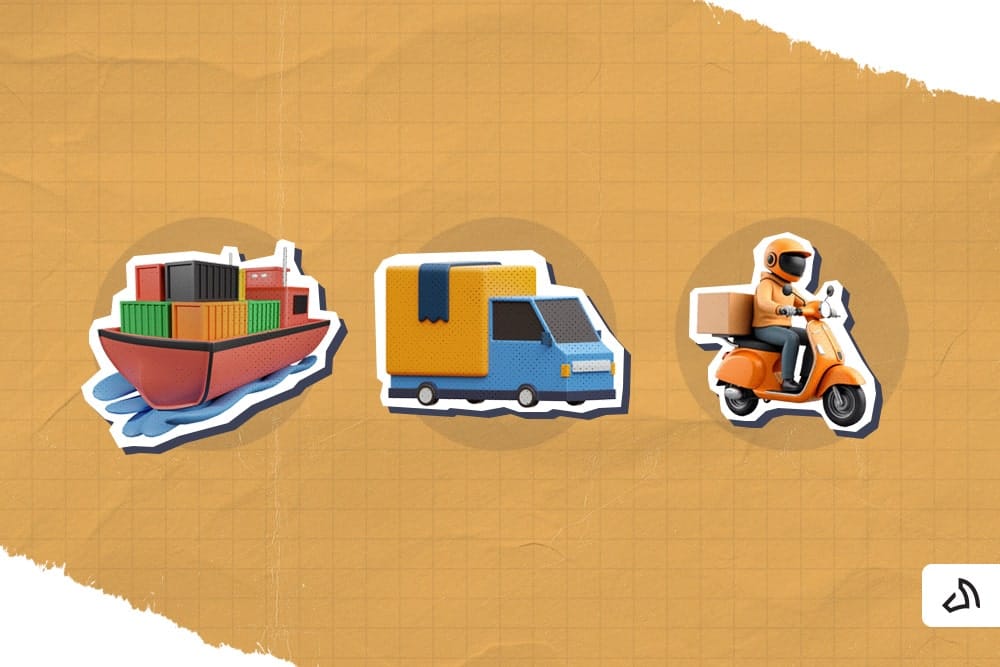
So, what does a 2PL look like in the real world? These companies come in different forms, but they all share the same goal: moving goods from one place to another as part of effective supply chain management. Here are some common examples:
It's easy to confuse 1PLs, 2PLs, and 3PLs, but the truth is they serve different needs depending on the level of outsourcing a business requires. Let's break down the key differences factor by factor:
A 1PL setup means you handle everything yourself, from inventory management to shipping products using your own vehicle or a local post office. There's no external system involved.
With a 2PL, integration is minimal. You book shipments when needed, and that's the extent of the relationship.
In contrast, 3PL companies integrate directly with your eCommerce platform, so orders flow automatically into their system for fulfillment.
Under a 1PL model, you have complete control over every step: storing inventory, packing orders, and delivering them yourself. While that gives you full oversight, it also means more time and effort on logistics instead of growing your business.
Using a 2PL means you keep complete control over your inventory, storage facilities, and order fulfillment. Again, their sole focus is on moving goods from point A to point B.
On the other hand, a 3PL takes that responsibility off your shoulders. Not only do they deliver the products to your customers, but they also handle fulfillment and storage on your behalf. It's less hands-on for you, but it creates a more efficient supply chain as your business grows.
With a 1PL, your costs mainly come from maintaining vehicles, storage spaces, and staff—expenses that can add up quickly as your order volume increases.
At first glance, 2PL services are often cheaper since you pay per shipment and don't have to commit to larger contracts. But as your sales volume grows, you also need to scale up. Managing everything yourself can eat up time and resources, leading you to lose time in other aspects of your business.
A 3PL provider usually requires a higher investment, but it pays off by saving you time, reducing overhead, and creating smoother logistics overall.
A 1PL setup works best for small businesses or startups that handle everything on their own—think local sellers who personally deliver orders to nearby customers.
As for 2PLs, they work best for sellers who only require transportation, such as sending bulk orders to Amazon FBA or moving goods between warehouses.
A 3PL, however, is the right choice if you're ready to scale and need a partner for outsourcing logistics. They will manage the entire picture: fulfillment, cross-border shipping, and even reverse logistics.
Here's a table highlighting the key differences, making it easier for you to compare them:
| Factor | 1PL | 2PL | 3PL |
| Integration | No external integration. The seller manages everything manually in-house | Minimal—mainly booking shipments | High—connects with your eCommerce platform for automation |
| Control | Full control over inventory, packing, and delivery | The seller manages inventory and fulfillment. | The provider manages fulfillment, storage, and delivery for you. |
| Cost | Higher operational costs due to owning and maintaining vehicles, staff, and storage space | Lower upfront, pay per shipment | Higher investment but saves time and resources long term |
| Best For | Small or local sellers handling all logistics themselves | Sellers who only need transportation | Sellers ready to scale with storage, fulfillment, and more |
Similar Read: 3PL vs 4PL: Key Differences, Benefits and How to Choose the Right One
So why would a seller choose a 2PL instead of jumping straight into 3PL? Here are some advantages of selecting one as your external logistics:
By now, you can see that 2PLs are an excellent option for Canadian sellers who need transportation services. However, as your business grows, it is essential to understand that logistics management becomes increasingly complex. You will need someone to handle storage, shipping, and returns separately.
At Stallion, we're more than just a shipping service. We're a full 3PL partner offering logistics outsourcing for Canadian businesses. Whether you need warehousing, cross-border shipping to the US, or complete eCommerce fulfillment solutions, we've got you covered.
Scale smarter and streamline your growth with Stallion.

Jose is Stallion's Senior Business Analyst. He helps improve the company’s shipping processes, works closely with delivery partners, and looks at shipping data to find the best prices for our customers. Outside of work, Jose has a passion for running, regularly completing 5k and 10k runs, with the goal of running a full marathon in the near future.
Can our fellow Torontonians relate?
-
#smallbusiness #business #entrepreneur #socialmedia #shipping #ecommerce #canadianecommerce #shopify #poshmark #b2b #saas #etsy #ebay #canada #canadiansmallbusiness #shoplocalcanada #entrepreneur
#toronto

Here’s your quick hassle free shipping from 🇨🇦 to 🇺🇸 as a business owner!
-
Any questions?! Leave them 👇🏻 and save this video so you don’t forget!
-
#smallbusiness #business #entrepreneur #socialmedia #shipping #ecommerce #canadianecommerce #shopify #poshmark #b2b #saas #etsy #ebay #canada #canadiansmallbusiness #shoplocalcanada #entrepreneur
Meet @drinkbenny a 🇨🇦 female founded energy drink brand! Instead of focusing on their products, they’re taking a unique approach by hosting in person events in different Canadian cities to offer an experience for their community 🧡
-
What are your thoughts on in person events? 💭
-
#smallbusiness #business #entrepreneur #socialmedia #shipping #ecommerce #canadianecommerce #shopify #poshmark #b2b #saas #etsy #ebay #canada #canadiansmallbusiness #shoplocalcanada #entrepreneur
Do you know the difference between DDU and DDP when shipping internationally 🌏 ?
-
Questions? Leave them below! 👇🏻
-
#smallbusiness #business #entrepreneur #socialmedia #shipping #ecommerce #canadianecommerce #shopify #poshmark #b2b #saas #etsy #ebay #canada #canadiansmallbusiness #shoplocalcanada #entrepreneur
Here’s a quick hack to save time from choosing multiple postage options
↪️ Turn on the lowest postage rate automation to save you time!
-
Questions? Leave them below! 👇🏻
-
#smallbusiness #business #entrepreneur #socialmedia #shipping #ecommerce #canadianecommerce #shopify #poshmark #b2b #saas #etsy #ebay #canada #canadiansmallbusiness #shoplocalcanada #entrepreneur